
Fuel for the Fintech Fire
Embedded Finance Is the New Plumbing of Money
General advice only – prepared for Wholesale/Sophisticated/Professional Investors. See full disclaimers below.
Moving money has never been easier.
You tap. The screen flashes. Transaction complete.
It looks instant. It feels effortless.
But that three-second moment? Behind it sits an entire hidden universe. A chaotic tangle of identity checks, fraud scans, risk calculations, regulatory verifications, and settlement logic all firing in perfect sequence.
One broken link, and the whole thing collapses.
You never see this machinery. You never think about it.
And that's precisely the point.
The companies that master this invisible chaos don't become famous. They become irreplaceable.
Think back to the early internet. The biggest winners weren't always the flashy consumer apps. They were the infrastructure players. The ones who figured out how to move data securely, reliably, at massive scale.
The pipes, not the faucets.
Today, the same shift is happening in finance.
Every modern financial interaction like opening an account, verifying your identity, linking a bank, detecting fraud, clearing a payment, now carries an instant expectation. We want the Uber experience everywhere.
Tap once, and let the complexity vanish into the background.
That single demand created an entirely new category called embedded finance.
Not banking. Not fintech. The layer underneath both.
It's the invisible wiring that lets a rideshare app hold your money, a brokerage open accounts instantly, or a neobank verify you in seconds. It's what allows software to act like a financial institution without actually building one.
And the pressure on this wiring is intense.
Regulators demand tighter controls. Fraudsters deploy AI-generated fakes. Platforms onboard users 24/7. Transactions multiply every second. Customers won't tolerate friction. Executives won't tolerate risk.
Something has to reconcile these competing forces.
Something intelligent. Something fast. Something bulletproof.
That ‘something’ is infrastructure. The decision engines, verification systems, and workflow pipelines that absorb all the complexity so users see none of it.
When it works, nobody notices.
When it breaks, everything stops and everybody notices.
Accounts freeze. Payments fail. Regulators circle. Trust evaporates overnight. That's the paradox of infrastructure. Its success is invisible, its failure catastrophic.
And that's exactly what makes it so powerful.
How often do you think about the roads you drive on? I’d wager a pretty penny you only think about them when there’s a problem. Not enough lanes, too many potholes, too many speed bumps...
Companies that build this core machinery don't grow through advertising. They grow through integration. Once plugged in, they become part of a customer's operating system. Woven into workflows, critical to daily operations, impossible to replace without tearing everything apart.
This is the blueprint behind some of tech's greatest compounders. The quiet operators embedded in global systems. They weren't sexy on day one. They weren't household names.
They just solved the hardest problem in the stack. How to make complexity disappear. Now finance is going through its own infrastructure revolution.
The old pipes weren't built for digital banks, gig-economy income, instant verification, or AI-powered fraud. They can't handle platforms onboarding 50,000 users in a day. They weren't designed for billions of micro-decisions happening in real time.
So the pipes are being rebuilt.
New infrastructure companies are stepping in. They’re handling identity, risk, payments, document intelligence, and compliance in ways legacy systems simply can't match.
They're becoming the unseen engines powering modern financial experiences.
Essential. Embedded. Sticky.
And positioned for explosive growth.
Because every time money moves in the digital economy, they move with it. Taking their small fee on each transaction. Just a tiny, unnoticeable fee.
Multiplied by billions and billions of transactions per day.
That’s a powerful combination.
That's the backdrop of this report.
A global infrastructure shift happening in real time. A new financial layer being carved out beneath our feet.
And a tiny ASX company that's quietly positioned itself right in the center of it all.
It’s time. A new Explosive Growth opportunity is taking shape…
Stakk (ASX:SKK) is an Australian embedded finance company. It’s the kind of business you don’t see directly as a user, but one that quietly determines how other platforms can operate at scale.
The product suite, Stakk IQ, plugs into apps, neobanks, fintechs, credit unions, and digital platforms, powering the workflows that make sign-up and high-risk actions frictionless and compliant.
Think of it like the screening system inside a busy airport. Travellers want to walk straight through, regulators want strict security, and the whole operation falls apart unless the verification layer is both fast and airtight.
That’s what Stakk builds. The screening layer for digital finance.
This positioning matters because the category is exploding. The number of decisions modern platforms must make per user has skyrocketed, while the complexity of verification, fraud detection, and regulatory compliance has increased even faster. It creates a tension most companies can’t solve on their own.
Which explains why Stakk’s infrastructure is now used across more than 210 banks, credit unions, neobanks, and fintech platforms in the United States and Australia, giving it a rare footprint for an ASX microcap.
With a market capitalisation of ~$95 million at the time of writing, it’s flying well under the radar.
Stakk is led by founder Andy Taylor, who has one of the strongest entrepreneurial track records in the Australian fintech landscape.
Andy co-founded SocietyOne, one of Australia’s earliest and most successful peer-to-peer lending platforms. He also founded Unity ID, a marketing and technology agency.
He’s been through the grind of start-up cycles, managed growth, faced down the hard problems and pushed products into market in industries that don’t forgive mistakes.
Founders run companies differently.
They’re not a hired suit, focused on their bonus and landing their next role.
Founders are building their legacy. They’re emotionally invested in the success of something they built from the ground up. They’ve also delivered all the growth and the success in the business to date.
As we’ll dig into shortly, Stakk has already made a massive pivot.
The person who rebuilt the company is the same person still driving it today. That gives us conviction that if things get tough again in the future for Stakk, Andy isn’t going to call it quits and run. He’s going to stick around to see the job done.
With a small market cap, accelerating platform usage and a founder who has already delivered multiple operational wins, Stakk enters this next phase with a hard to find combination on the ASX. And we like it.
This is the company we’re covering today.
Why Stakk?
Modern financial software is built on workflows. Chains of logic that determine what happens when a user uploads a document, triggers a risky action, or attempts to move money.
These workflows used to be handled manually by teams of analysts. Today, they need to run automatically, in real time, under immense pressure.
That’s the environment Stakk IQ is designed for.
It’s a modular infrastructure platform that handles everything from image capture to document intelligence, verification, identity checks, workflow orchestration, and real-time risk scoring. The modules snap together like components of an operating system, allowing platforms to automate complex tasks at scale.
Capture IQ ingests documents, images, and data, converting messy user inputs into structured information.
Auth IQ handles the verification, matching identities, detecting tampering, and confirming legitimacy.
Risk IQ analyses behaviour, flags anomalies, and scores risk in milliseconds.
Flow IQ automates the entire journey, ensuring each user takes the correct path based on their risk profile or regulatory requirements.
Score IQ adds predictive intelligence, improving over time as more data flows through the system.
Settle IQ governs the ‘should this money move?’ logic inside high-risk financial actions.
Individually, these tools handle essential steps. Together, they replace entire internal teams.
For Stakk’s customers, the integration is simple. They build a step into their software platforms to send a message through an Application programming Interface (API). Think of an API as a module you can attach to a piece of software or code, that allows it to communicate with another piece of software.
Stakk’s systems receive the message, process the data and send a response back.
It’s effectively an outsourced decision.
Stakk’s biggest advantage is how deeply it integrates. Once a company plugs in Stakk IQ, the platform becomes embedded inside hundreds of workflows, from onboarding to document analysis to transaction decisioning. That creates enormous operational stickiness. Switching becomes risky, expensive, and disruptive.
Cross-selling becomes a breeze. Once customers see one module working seamlessly, reducing their workload and improving customer turnaround times, the next module becomes an easy sell.
The second advantage is scale. Stakk’s revenue model grows with customer usage — more documents, more verifications, more transactions. As customers grow, Stakk grows with them.
The third advantage is validation. The platform already supports workflows across more than 210 institutions, from fintechs to credit unions to neobanks. For a company of Stakk’s size, that level of embeddedness is exceptionally rare.
In a market where companies no longer have the time, resources, or regulatory tolerance to build this infrastructure internally, Stakk offers a ready-to-deploy system that’s already proven at scale.
That’s why this category is exploding and why Stakk’s technology sits in a uniquely leveraged position.
The Pivot
Stakk’s origins trace back to Douugh, a consumer-facing fintech chasing neobank-style growth. The idea was ambitious, but the economics of consumer fintech were tough. High marketing spend, heavy competition and low-margin monetisation made the model difficult to scale sustainably.
But hidden inside Douugh was something far more valuable. The infrastructure.
Think of this pivot as like a mining company that invested heavily in a processing plant, but didn’t find any gold. Suddenly, they’ve got gold miners all around them knocking down the door to rent their processing plant.
Only in this case, that processing plant is infinitely scalable. You can process as many tonnes as you can find. And the gross margins? Lofty! Operating leverage on this kind of business is through the roof. We’ll dig into that further in the financials section.
The team built identity systems, fraud logic, document intelligence pipelines, workflow automation and risk scoring engines to run the Douugh experience. And those internal tools turned out to be better businesses than the app itself.
Recognising this, they pivoted decisively. Douugh became Stakk. The consumer app was phased out. The infrastructure was rebuilt into a modular platform. And the business shifted to serving enterprises rather than end users.
Over the past 12 months, the pivot has gone from idea to reality.
The platform matured. The modules strengthened. The company secured large enterprise customers in the US. And receipts began growing rapidly as workflows moved into production.
By Q1 FY26, the shift was undeniable. Record receipts, record monthly revenue, and usage contributing real, compounding momentum month after month.
The roadmap from here is clear:
1. Expand workflows within existing customers.
Companies often start with one module (e.g. image capture) and expand into document intelligence, risk, authentication and automation.
2. Broaden into new verticals.
Anywhere identity and risk matter, like gig platforms, marketplaces, digital onboarding, credit, Stakk can integrate.
3. Strengthen intelligence.
As more data flows through the system, the models become smarter, faster and more accurate, a major competitive edge.
The pivot story is important company lore, but that’s been successfully pulled off. It’s not a what-if anymore. It’s done.
Stakk is now an early-stage infrastructure company with real Product-Market Fit (PMF), real usage and real momentum.
Financials
Stakk’s financial profile has changed dramatically over the past two quarters. The company has gone from modest receipts to early hypergrowth as major US enterprise integrations begin contributing to revenue.
Anyone looking at the full year financials in Comsec or Nabtrade is completely missing the picture. There they’ll see an FY25 revenue of $1.2 million, a net loss of $200 thousand, and a cash balance that can be rounded down to zero.
Sure, that’s a great improvement from the $1.2 million in revenue in 2022 and net loss of $11.6 million. But there’s not much to get excited about in these numbers.
It’s post FY25 that things get spicy.
Q1 FY26 receipts hit $871k, up 1,836% year-on-year, driven by early-scale usage from newly-won US financial platforms. This result landed before revenue from several major contracts even came online.
In October alone, Stakk generated $575k, up 146% month-on-month and 9,467% year-on-year, marking the strongest month in the company’s history. This shows the flywheel is already engaged, with modules like image capture, OCR, document orchestration, authentication and risk intelligence now running at enterprise volume.
Annual Recurring Revenue (ARR) is expanding even faster.
Stakk reported $2.78m ARR as of September. On the 20th of November they announced a strategic partnership with Stride Bank, casually mentioning its ARR was ‘blowing through its previously-projected $8.0m annualised ARR milestone...’.
That’s a ~200% lift in contracted revenue in less than two months.
Since then they announced an expansion of scope with T-Mobile USA to include Risk IQ and Auth IQ. The expansion is expected to have a ‘material impact on the anticipated revenue trajectory of the relationship.’
If we were to see a further 200% uplift in ARR before the end of the year, that would put it at $24 million. Certainly something in the $15-20 million range looks possible.
The balance sheet has also strengthened considerably. The company raised $15m post-quarter, lifting cash to roughly $16m and giving it ample runway to execute its integration-heavy next phase.
Stakk is reinvesting in growth, with R&D increasing to $1.27m, operating costs at $693k and staff costs at $78k for the quarter. Costs are still lean relative to its customer base and US expansion, and it’s critical that they stay ahead of the competition. Complacency in this fast-moving space is not an option.
So, while we expect Q2 FY26 to be cash-flow positive, we’re prepared to see costs ramp up as the business scales.
Software businesses like this tend to have extremely high Operating leverage. This is because the marginal cost of selling one more unit of software is very low. Gross margins are often in the 70-90% range.
That means that every new dollar the business brings in will have a strong flow on effect to the bottom line. The caveat here is that we expect the company to increase fixed costs to support growth in the short term.
Risks
Every early-stage infrastructure company carries risk. Stakk is no exception. The company is scaling fast, winning large US customers and embedding itself into high-volume financial workflows. But that acceleration amplifies certain vulnerabilities that investors need to understand clearly.
Customer concentration
Although Stakk has integrations across more than 210 financial institutions, the reality is that a handful of high-volume US customers could drive the majority of revenue over the next 12–24 months. If the rollout of any major client slows, changes scope, or suffers delays, receipts could become lumpy. Enterprise contracts are sticky once deployed, but the pathway from signing to full production can vary, and early-stage scaling curves are rarely smooth.
Competition
While Stakk has a unique modular stack, it competes in parts of the market occupied by well-funded US and global players ranging from document-intelligence providers to fraud-decisioning platforms. Many of these rivals have deeper balance sheets, and although Stakk’s integration-led stickiness provides strong defensibility, the company must continue improving accuracy, speed, and intelligence to remain ahead. Falling behind in detection quality or workflow automation could weaken its position over time.
Regulatory and compliance
Stakk operates inside the most tightly regulated domain of the digital economy, that of financial identity, verification, and risk. Regulatory frameworks evolve constantly, especially in the US. A significant change in compliance requirements could force the company to accelerate development, expand infrastructure, or overhaul models at short notice. Although this environment creates demand for Stakk’s services, it also raises the bar for continual adaptation.
Security
Stakk processes sensitive financial data and identity information. A breach could carry reputational damage far beyond its size. The company’s value proposition relies on trust, accuracy and security. Any compromise in these areas could materially impact onboarding demand or slow new customer acquisition.
Cashflow and dilution
While Stakk has strengthened its balance sheet with fresh capital, the transition into high-volume operations, especially across the US, will require disciplined execution. Infrastructure companies often endure a period where engineering, customer support and integration costs rise before revenue fully reflects usage growth. Mismanagement of this phase can create funding pressure, even when long-term economics are strong. This also raises the risk of capital and debt raises on unfavourable terms.
Stakk is in a powerful emerging position, but to fully capture the upside, the company must navigate operational, competitive and regulatory challenges with discipline. The opportunity is big, but so are the hurdles.
In Summary
The big question on investors’ minds is if this is just the start of a rampant growth story for Stakk, or are they just having a fluke year, with things to slow down again in FY27?
The Q2 FY26 quarterly cashflow report to be released in January could provide valuable insight into the next twelve months for SKK.
Sign up HERE to access your free copy of our full report, including the outlook and our take on how to play Stakk.
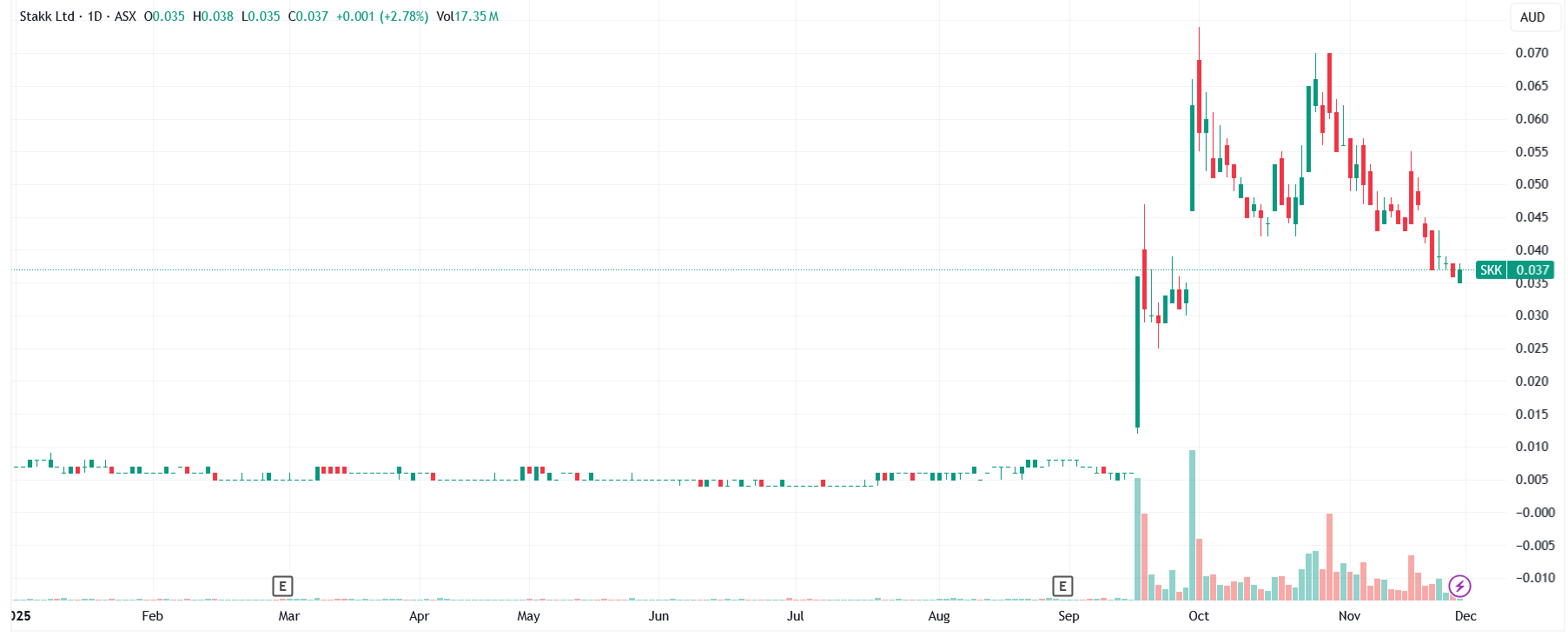
Stakk (ASX:SKK) Daily Price Chart (Source: Tradingview)
This publication has been prepared by The Markets IQ, a division of Vitti Capital Pty Ltd (ABN 13 670 030 145), which is a Corporate Authorised Representative (001306367) of Point Capital Group Pty Ltd (ABN 41 625 931 900), the holder of Australian Financial Services Licence 518031. This report is for general information only and does not take into account your objectives, financial situation, or needs. It is not personal financial advice or a recommendation to buy, hold, or sell any security. You should consider whether the information is appropriate in light of your circumstances and obtain professional advice before making any investment decision. This report is intended solely for wholesale, sophisticated, or professional investors within the meaning of the Corporations Act 2001 (Cth).
Any views, probabilities, valuations, technical levels, or forecasts expressed are strictly the opinions of the authors as at the date of publication, based on publicly available information and assumptions which may change without notice. They are illustrative only and not predictive of future outcomes. Past performance is not a reliable indicator of future performance.
Directors, staff, or clients of Vitti Capital may hold positions in Audeara (ASX:AUA) or related securities at the time of publication. Such holdings may change without notice. Vitti Capital applies internal controls to manage potential conflicts of interest; however, readers should assume that conflicts may exist.
The analyst(s) responsible for preparing this research note certify that the views expressed in this report accurately reflect their personal views about Audeara (ASX:AUA) and its securities. No part of their compensation is, or will be, directly or indirectly related to the specific recommendations or views expressed herein. The analyst(s) and/or their associates may hold an interest in Audeara (ASX:AUA).
